
Quotation Follow-Up Email: How to Follow Up After Sending a Quote, With Samples
How to follow up after sending a quotation: a simple email and WhatsApp schedule for exporters, with lines you can copy and one rule for each message.
You sent the quote. The buyer asked good questions, said "thanks, will check", and went quiet.
Silence after a quote rarely means a firm no. More often the buyer is comparing three suppliers, waiting on their boss, or simply buried. Your job is to stay easy to say yes to, without becoming the supplier who sends "Any update?" every two days.
This guide is for small exporters and B2B sellers quoting physical products to overseas buyers. If you met the buyer at a trade show, start with our Day 1–90 trade show follow-up plan first. This post picks up at the point where a quotation has gone out.
Before you send: make the quote easy to follow up
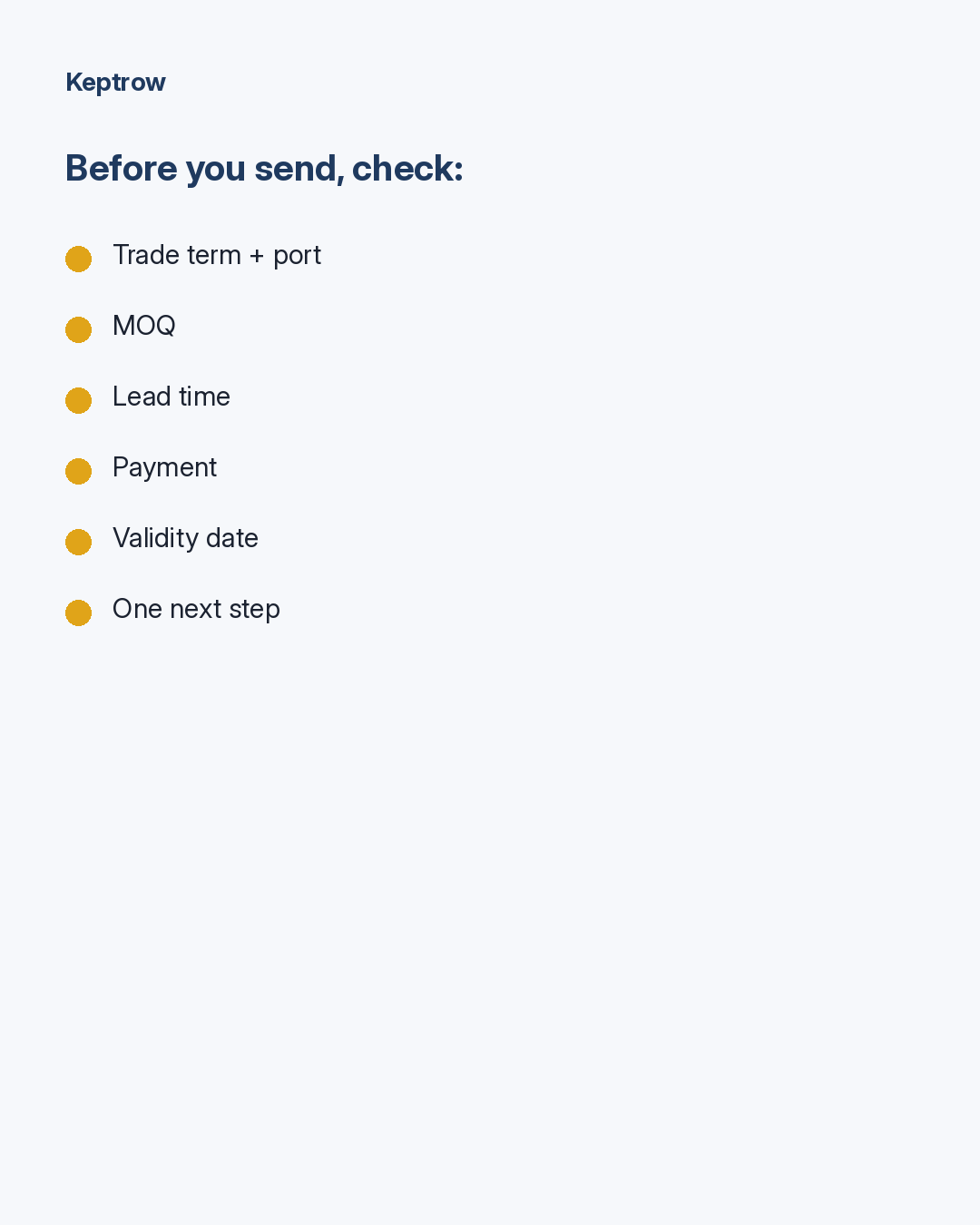
Most follow-up problems start in the quote itself. Before you hit send, check that it states:
- Trade term and port: FOB, CIF or EXW, and where.
- Minimum order quantity and the price at one or two higher quantities.
- Lead time from deposit or sample approval.
- Payment terms.
- A validity date: "Prices valid until [date]."
- One next step: "Reply with your target quantity and I'll confirm the delivery date."
The validity date matters most. It gives you an honest reason to write later. That's very different from a fake "price going up tomorrow" message.
Also tell the buyer when you'll check in: "I'll follow up on [day] in case you have questions." Then the follow-up is expected, not intrusive.
The schedule: who gets what, and when
Use email for anything with numbers or attachments. Use WhatsApp for short nudges, but only if the buyer has already chatted with you there. Unsolicited WhatsApp messages feel like spam.
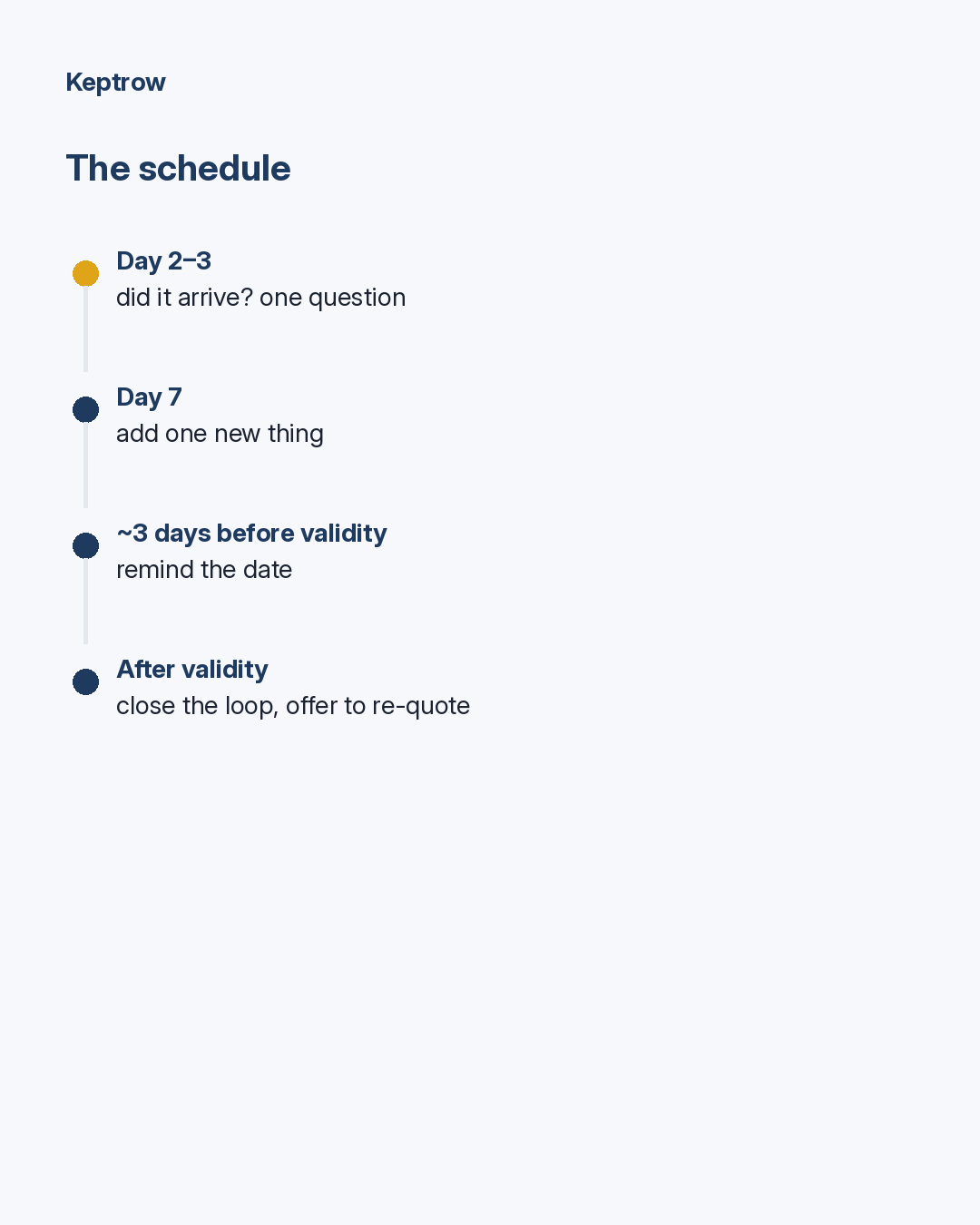
- Day 2–3, email: check the quote arrived and was clear. One question.
- Day 2–3, WhatsApp (optional): a one-line heads-up that the email went out, if they use WhatsApp with you.
- Day 7, email: add one new thing they didn't have before.
- About 3 days before the validity date: a factual reminder of the date.
- After the validity date: close the loop politely and offer to re-quote.
Count working days in the buyer's time zone, and send in their morning. A message that lands at 3 a.m. their time sits under everything that arrives after it.
Stop the schedule the moment they reply. Then you're in a conversation, not a sequence.
A real schedule, with dates
Here is the same schedule on one fictional quote: QT-2026-0142 for 1,000 bamboo trays (the example from our export quotation format guide), sent to a buyer in Hamburg on 17 October 2026 and valid until 30 November 2026.
| Date | When | What you send |
|---|---|---|
| Sat 17 Oct | Quote day | The quotation, with "I'll follow up on Wednesday in case you have questions." |
| Wed 21 Oct | 3rd working day | Email: did it arrive? One question. WhatsApp heads-up only if they already use it with you. |
| Tue 27 Oct | About a week later | Email: one new thing, e.g. photos of the packing they asked about |
| Fri 27 Nov | 3 days before validity | Email: the quote is valid until 30 November |
| Tue 1 Dec | After it expires | Email: close the loop, reply 1, 2 or 3 |
Send each one around 9:00 Hamburg time. From China that's 15:00 until the clocks change in Europe on 25 October, and 16:00 after that.
If the buyer replies at any point, the rest of the schedule stops.
When to stop
Stop the follow-ups when:
- They reply. You're in a conversation now, not a sequence.
- They say no. Thank them and mark the quote Not pursuing.
- They say "not now". Ask when to come back, put that date in your Next follow-up column, and stop until then.
- You've sent the closing message. If that gets no answer either, stop. Write again only with a real reason (see "30 days or more later" below).
Quotation follow-up email format
Every follow-up on a quote has the same five parts:
- Subject with the quote number and product, so the buyer can find the quote in seconds.
- One line of context: which quote, and when you sent it.
- One new piece of information: a photo, a spec, a confirmed lead time or the validity date.
- One question they can answer in a line.
- Sign-off with your name, company and WhatsApp number.
Reply in the original email thread instead of starting a new one. The quote, the buyer's questions and their attachments then stay together, and nobody has to search for the PDF.
A fictional example, with the parts labeled:
Subject: Re: Quotation QT-2026-0142: bamboo trays, 1,000 pcs   [quote number + product]

Hi [Name],

Following up on our quotation of 17 October for the 40x30 cm    [context]
bamboo serving trays.

We can confirm a 35-day lead time for 1,000 pcs if the          [new information]
deposit arrives by 31 October.

Would you like us to send the sample set first?                 [one question]

[Your name], [Company]                                          [sign-off]
WhatsApp: [number]
Subject lines for quotation follow-up emails
Always include the quote number. The buyer can search for it, and your email sits next to the quote.
- Quotation QT-104: any questions?
- Quotation QT-104: delivery date for 1,000 pcs
- Quotation QT-104: photos of the packing you asked about
- Quotation QT-104: spec sheet for [material]
- Quotation QT-104: sample set ready to ship
- Quotation QT-104 is valid until [date]
- Quotation QT-104: shall I close it on my side?
- Updated quotation QT-104-R1 for [product]
What to say: lines you can copy
Change the words in brackets. Keep every message short. The quote document holds the detail.
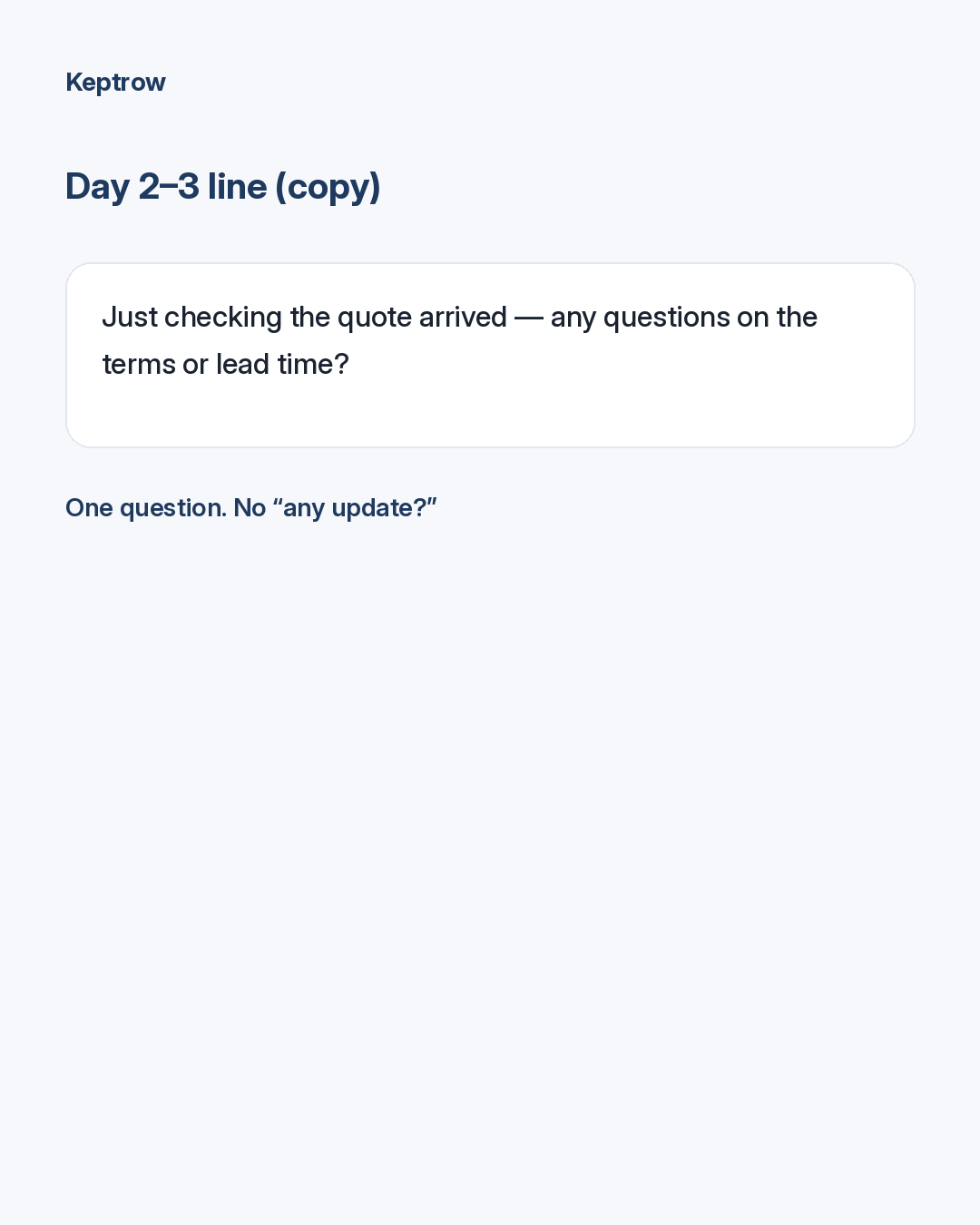
Day 2–3: did it arrive?
Subject: Quotation [QT-104] for [product]: any questions?
Hi [Name],
Just checking that our quotation for [product] reached you and is clear. If it helps, I can also quote [a second quantity / a different packing option].
Is [target quantity] still the right quantity for your first order?
WhatsApp version, if you already chat there:
Hi [Name], it's [your name] from [company]. I sent the quotation for [product] to your email on [day]. Happy to answer any questions here.
Day 7: add one new thing
Pick one, and only if it's true:
- A photo or short video of the exact item, packing or label they asked about
- A spec sheet or test report for the material
- Confirmed production slot or lead time for their quantity
- An alternative that solves a concern they raised, such as a lower MOQ in one color
Subject: [Product]: [the new thing] for your review
Hi [Name],
You mentioned [their concern, e.g. the carton size]. I've attached [photo / spec / video] so you can check it before you decide.
Would a sample help, or would you prefer to compare the full specs first?
Before the validity date
Subject: Quotation [QT-104] is valid until [date]
Hi [Name],
A quick note that the prices in quotation [QT-104] are valid until [date]. If you need more time, tell me and I'll check whether we can extend it.
Only say prices may change if that's genuinely the case. Never invent urgency. Buyers who compare suppliers can usually tell.
After it expires: close the loop
Hi [Name], I haven't heard back about [product], so I'll assume the timing isn't right and close this quotation on my side. Could you reply with the number that fits?
- Still interested, please re-quote in [month]
- We chose another supplier this time
- Only send me new products
A "2" is useful. You stop guessing, and you can ask what decided it.
30 days or more later: re-quote
If the quote expired a month or more ago, don't send "Any update?". Write again only with a real reason: a new price, a new production slot or a new item. Then send a fresh quote with a new number and a new validity date.
Subject: Updated quotation QT-104-R1 for [product]
Hi [Name],
We quoted you [product] in [month]. [The real reason, e.g. we have a production slot in March / the price at 3,000 pcs has changed.] I've attached an updated quotation, valid until [date].
Is [quantity] still the right quantity for you?
When the buyer replies "too expensive"
Don't cut the price in your next message. A fast discount teaches the buyer that waiting pays. Ask a question first:
Thanks for telling me. To see what we can do, could you share your target price and quantity? Sometimes a change in packing, color count or order size gets closer without cutting quality.
Then you're negotiating on facts, not guessing.
"We'll check with our manager"
Ask when they expect to decide, and offer what would help them get a yes:
Of course. When do you expect to decide? If it helps your manager, I can send [a sample / the test report / a quote for a smaller first order] before then.
Then follow up on that date, not before.
"Another supplier is cheaper"
First check you're comparing the same thing. A FOB price and an EXW price aren't the same, and neither are prices at different minimum quantities.
Thanks for telling me. So I can compare fairly: is their price FOB or EXW, and for what quantity? If the terms are the same, I'll see what we can do on packing or order size.
Following up on samples you sent
When the courier shows the samples delivered, wait 2–3 working days, then ask one question:
Hi [Name], the samples of [product] arrived on [date]. How did the [finish / size / color] look to your team?
Five mistakes that kill quotes
- "Just checking in" with nothing new. Answering it gives the buyer nothing. Every message needs a question or a new piece of information.
- Following up daily. Two to four touches over the validity period is plenty for one quote.
- Switching channels without a reason. Email first. WhatsApp only where they've already talked to you.
- Discounting in the first follow-up. See above.
- Losing track. You quoted 20 buyers last month. Which ones are due today? If you can't answer in ten seconds, follow-ups get missed.
Keep track without a CRM
The last mistake is the expensive one. A simple sheet fixes it. Give each buyer a row with the quote date, what they asked about, what you promised to send, the next follow-up date and a status (following up, replied, won, not pursuing). Then each morning, filter for today and overdue.
Want the tracking part already built? Start free
The Free Lead Follow-Up Tracker (Lite) has room for 5 leads and two follow-up steps (Day 1 and Day 7). You can see how the Today list and pre-written email and WhatsApp messages work before you use it on real buyers. Use it on a computer: it works in Google Sheets and LibreOffice and is built for Excel with standard formulas only.
Need more room? The full version ($12) holds 300 leads with 7 follow-up steps (Day 1 to Day 90), A/B/C grades and 7 editable templates, and you can change the days on the Settings tab.
Neither version sends anything for you. You check each draft and send it yourself.
Still putting the quote itself together? The Free Export Quote Template puts price breaks, MOQ, lead time and deposit on one A4 page. It works in Google Sheets and LibreOffice and is built for Excel with standard formulas only.
FAQ
How long should I wait to follow up after sending a quotation?
Two to three working days in the buyer's time zone for the first check-in. Then about a week later, with something new.
Should I follow up on WhatsApp or email?
Email for anything with prices, specs or files. WhatsApp for short nudges, only if the buyer already uses it with you.
How many times should I follow up on one quote?
Two to four times before the validity date runs out, then one closing message.
What if the buyer says the price is too high?
Ask for their target price and quantity before changing anything.
How do you write a follow-up email after sending a quotation?
Put the quote number and product in the subject, then one line of context, one new piece of information and one question. Reply in the same thread as the quote.
What is a good subject line for a quotation follow-up email?
One with the quote number and a specific topic, for example "Quotation QT-104: delivery date for 1,000 pcs".
Should I reply in the same thread or send a new email?
The same thread, so the quote, the buyer's questions and their files stay together. Start a new thread only when you send a new quote with a new number.
What should I write when the quotation has expired?
Close the loop politely and ask them to reply 1, 2 or 3. If you write again later, send an updated quote with a real reason and a new validity date.
Is it OK to call instead of emailing?
For a large order, a call can help. Confirm prices and details by email afterwards so there's a written record.
Also published on the Keptrow Gumroad store.